

Scenarios
Session 5.2 — Explore
The role of scenarios in futures thinking
Scenarios are central to futures studies and futures thinking competence. While definitions vary (Spaniol et al., 2019), common features recur. Scenarios provide structured ways to explore uncertainty and chart pathways to sustainable futures. Scenario development and planning—the practice of creating and using scenarios—also supports strategic preparation for multiple possibilities, and uncertainties of the futures.
| Definition: Scenario A scenario is a detailed exploration of a future possibility—a draft or a sketch of a hypothetical future. It may describe possible future states and/or possible developments towards them. (Puglisi, 2001; Börjeson et al., 2006) |
Typology of scenarios
Different types of scenarios can be seen as variants of the categories of probable, possible, and preferable and as “modes” of thinking about the future (Börjeson et al. 2006):
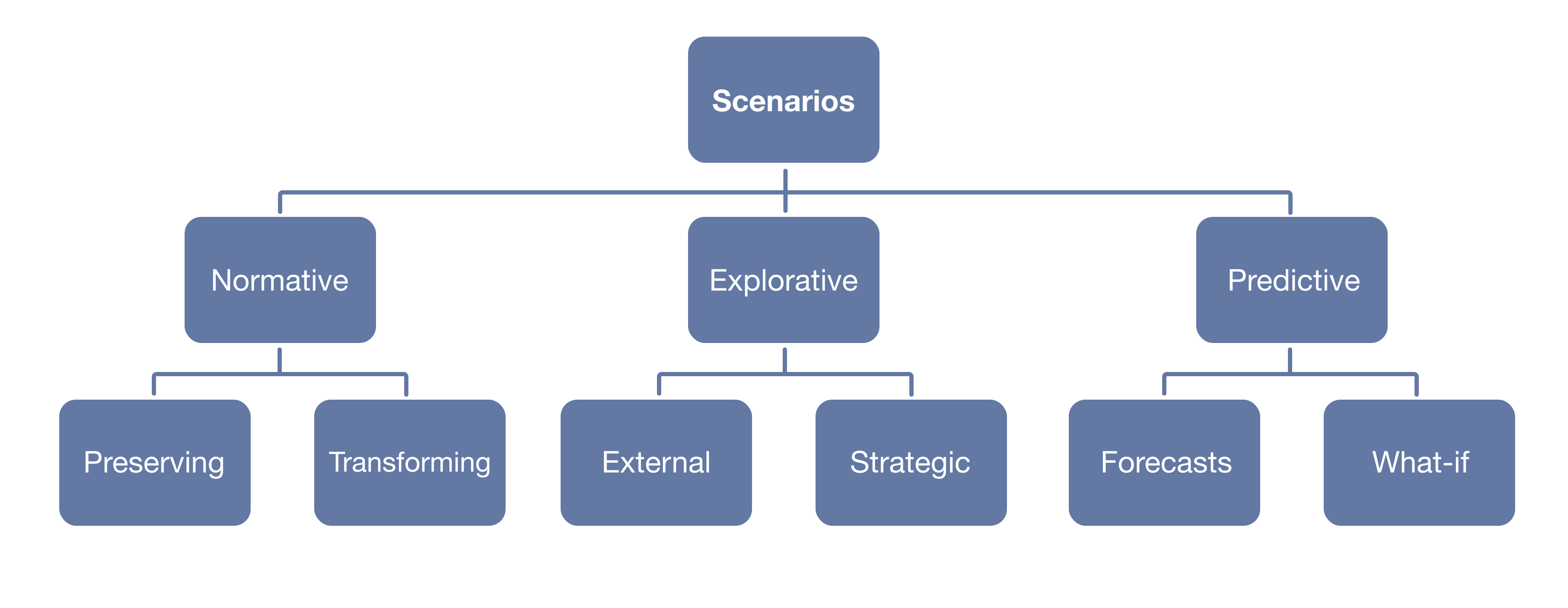
Scenarios can be grouped by the guiding question:
- Normative — How can a target be reached?
- Work backward from a desired end state within the bounds of the possible.
- Explorative — What can happen?
- Start from the present and explore plausible futures based on drivers and uncertainties (cf. Gordon, 1992).
- Predictive — What will happen?
- Often forward-looking forecasts based on trends and historical data.
Furthermore, within each category, one can identify two scenario types (see figure). These should be treated as rough landmarks rather than sharply defined, prescriptive boxes for different applications. For example, forecasts can be viewed as a distinct, specialized category of scenario work: they aim to estimate likely future outcomes by extrapolating historical data and current trends and place a premium on accuracy.
Trends as inputs to scenarios
In the creation of scenarios, the identification of trends can be particularly informative. Trends are patterns or tendencies observed over time in society, technology, economy, environment, or politics. They often serve as building blocks for scenarios.
- Megatrends: Large-scale, long-term shifts (e.g., climate change, demographics).
- Microtrends: Localized developments (e.g., rise of remote work).
- Emerging trends and weak signals: Early indicators that may become significant.
Trends inform scenario construction by revealing drivers and uncertainties. Scenarios may start by extrapolating trends, projecting current trends into the future to explore how they might develop under varying conditions. Stress-testing scenarios ask: What if trends stall, reverse, or collide? While trends provide the data and patterns and show direction, scenarios explore how they might play out across diverse conditions and choices.
Scenarios turn data and drivers into structured stories. You can use them to test strategies across plausible, possible, and preferred futures—and to design pathways toward the ones you value.
Pause and Reflect

* Which global (un)sustainability megatrends most influence your area of specialization?
* What weak signals from the past grew into pronounced trends?
Explore further

Supporting Material for the Teaching Format “Future Scenarios for Sustainable Business Solutions“
Download and explore this comprehensive material with various learning activities with detailed instructions.
(Marina Schmitz, Creative Commons-Lizenz – CC BY – 4.0 International )