

Building cool scenarios!
Session 5.1 — Let’s get started!
In this exercise you’ll practice the mechanics of scenario design and explore how to turn an (exemplary) observed trend into four scenarios.
Let’s start with a scientific observation which is, due to climate change, likely to become increasingly significant in the future:
“Extreme heat exposure impacts learning negatively”
Scope of the exercise: Higher education institution in your country
Time horizon of the exercise: 10 years
Step 1: Take paper and a pencil and draw a free format mindmap on this trend.
Collect your thoughts on topics such as
- Affected stakeholders
- Health impacts
- Questions of equity and vulnerable groups
- Potential co-hazards
- Infrastructure and technology view points involved
- Practices and operational choices in academic settings
- Pedagogical choices for teaching in heat wave conditions
- Economic impacts
- Policy responses
Remember also feedback loops and second order impacts.
Step 2: Draw and work on a 2×2 matrix
Choose two independent uncertainties around this trend, draw a 2×2 matrix, with qualitative endpoints for both x-axis and y-axis.
Typical endpoints include parameters such as slow/ fast, coordinated/fragmented, scale high/low; frequent/rare; affordable/costly, moderate/severe; etc.
Step 3:
Describe each quadrant with plausible outcomes (1-2 suffices) and risks and opportunities.
You can work with the template shown below, or if you wish, choose your own two uncertainties and create your own matrix.
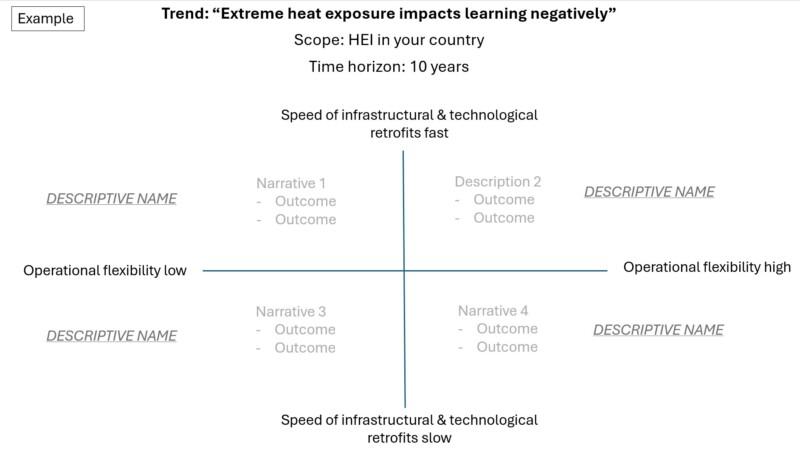
Step 4: You have created four scenarios! Can you give them a good name?
Explore further

If you got intrested in how heat affects learning, you can start by checking out following sources:
American Psychological Association, 2026: Schools must adapt to extreme heat in a warming world.
Cho, 2017: The effects of summer heat on academic achievement: A cohort analysis.
Méndez-Lázaro et al. 2025: Assessing the impacts, risks, and vulnerabilities of extreme heat in learning environments of Puerto Rico in 2023.